


DTF Transfers vs Screen Printed Transfers: Best Option for Print Shops in 2026
Print shops in 2026 are being pushed in two directions at once. Customers want faster turnaround, lower minimums, more customization, and full-color design freedom, yet they still expect tight margins and reliable repeat production. That is why more shop owners and decorators are comparing DTF transfers with screen printed transfers instead of simply defaulting to whatever method they have used for years.
Both methods let decorators apply completed transfers with a heat press rather than printing directly onto the garment during final fulfillment. That alone makes them attractive. But the similarities stop there. The setup logic, artwork limitations, production speed, reorder behavior, and cost profile of each method are very different. For a modern print shop, choosing the right transfer workflow changes which jobs are profitable, which jobs are stressful, and which jobs the shop can confidently accept every week.
If your shop serves local businesses, startup brands, schools, team programs, contract decorators, fundraiser accounts, event clients, or overflow wholesale demand, this comparison matters because you probably do not run only one kind of order anymore. The shops that grow in 2026 are rarely the shops that handle only one repeat design in huge quantities. They are the shops that combine bulk work with short runs, test orders, urgent deadlines, and design variation. In that environment, flexibility becomes a competitive advantage.
Why Print Shops Are Re-Evaluating Transfer Workflows
There was a time when the answer to most transfer questions was simple: if the job repeated enough and used limited colors, the shop leaned toward screen-based production logic. If the job was tiny or irregular, it was either quoted higher or declined. But the market changed. Clients now expect short runs, one-off variations, fast sample rounds, and multiple graphic placements without the friction that older workflows introduced.
That change matters for shops of every size. A local decorator serving ten business accounts may face just as much artwork variation as a larger facility. A small shop can no longer assume that clients will wait patiently for slow setup-heavy methods if a competitor can deliver faster. The same is true for contract and wholesale relationships. If an overflow partner can receive, print, and return a job with fewer setup delays, that partner becomes strategically valuable.
What Are DTF Transfers?
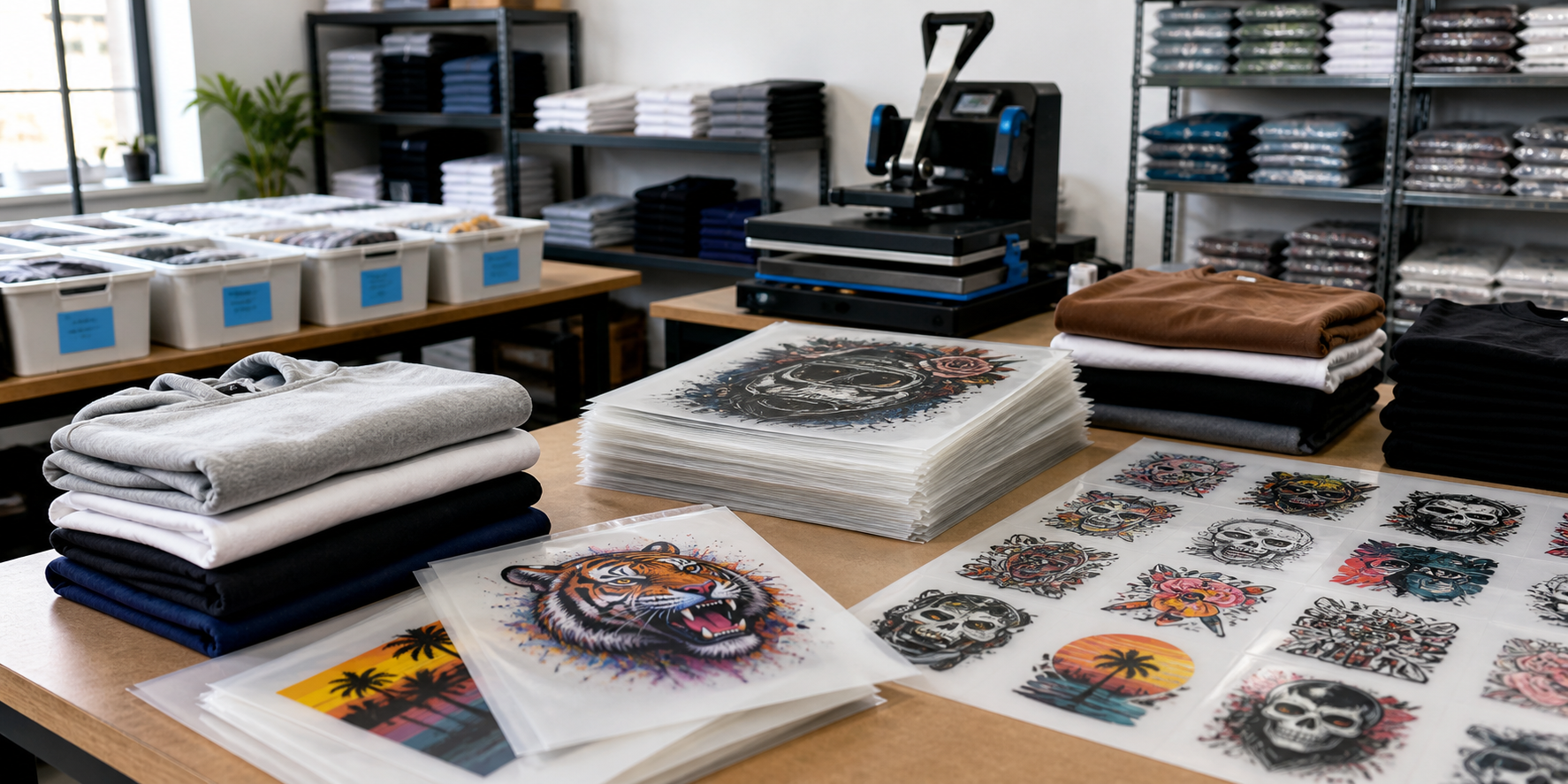
DTF transfers are digitally printed onto transfer film, coated with adhesive powder, cured, and delivered ready to press. Because the image is produced digitally, DTF supports full-color graphics, gradients, detailed logos, fine lines, and complex artwork without requiring a separate screen for every color.
That flexibility makes DTF particularly useful for mixed-order environments. A print shop can process client work that includes multiple logos, multiple garment types, small batch runs, and changing order profiles without being slowed down by the kind of setup burden associated with older methods.
Shops that want efficient supply options often rely on upload DTF gang sheet services or DTF transfers by size when they need fast, repeatable production support.
What Are Screen Printed Transfers?
Screen printed transfers are created using screen printing techniques, but instead of printing directly onto the garment, the design is printed onto transfer media and later heat applied. This means the shop still benefits from a heat-press application workflow, but the design production itself follows a more traditional screen-based setup logic.
Screen printed transfers are still very useful in the right environment. If a shop is producing the same design again and again in high volumes, especially with limited colors, screen printed transfers can be consistent, durable, and cost-efficient. They remain highly relevant for team programs, event orders, franchise apparel, standardized graphics, and recurring institutional jobs.
DTF Transfers vs Screen Printed Transfers at a Glance
| Factor | DTF Transfers | Screen Printed Transfers |
|---|---|---|
| Setup | Minimal digital setup, no screens for each color | More preparation and screen-based setup work |
| Artwork complexity | Excellent for full color and fine detail | Best for simpler spot-color graphics |
| Short runs | Strong | Less efficient |
| Repeat bulk jobs | Good but not always cheapest | Excellent for standardized high-volume work |
| Gang sheet logic | Highly efficient | Less naturally suited |

1. Setup and Production Agility
DTF transfers win immediately on flexibility. A shop can move from one design to the next without rebuilding the process around multiple color separations and screen setup for every new variation. In a shop where customer art changes daily, that is not a small convenience. It is a production advantage.
Screen printed transfers still make sense when the job justifies the setup. If the order repeats enough and the artwork is simple enough, the initial prep effort can be spread across a larger quantity. But for shops that handle many smaller jobs, frequent art changes, or same-week design variation, that setup can become a drag on throughput.
Production agility is not only about speed. It is also about mental load. A workflow that allows staff to move between customers without repeated setup burden often reduces bottlenecks, quoting hesitation, and in-house frustration.
2. Artwork Complexity and Color Freedom
This is where DTF often becomes the better tool for the modern market. If the design includes gradients, shadows, photo-style detail, subtle color transitions, textured logos, or small type, DTF handles that work far more naturally. A shop serving brands, artists, events, and visually demanding clients benefits from that range immediately.
Screen printed transfers still look excellent for clean, bold, spot-color art. That strength should not be ignored. But the moment a customer wants a detailed brand graphic, a visually layered back print, or a complex promotional design, DTF becomes easier to justify. The shop does not have to simplify the art just to fit the method.
In practice, that means DTF helps a print shop say yes to more jobs without redesigning client expectations. That is commercially valuable.
3. Short Runs and Mixed Orders
Most shops today do not live only on 500-piece orders. They live on mixtures: six shirts here, twenty hoodies there, twelve tote bags for an event, sample tees for a brand, and a restock order for a restaurant or contractor. DTF is often the better answer in that environment because it preserves order flexibility without making every new design feel like a special setup event.
Short runs also tend to come with last-minute changes. Names are added. Sizes shift. One client suddenly wants a sleeve print. Another changes the art after seeing a proof. DTF is more forgiving in that kind of reality because the workflow is already built around digital flexibility.
Screen printed transfers are less comfortable in that environment. They are best when the job is more standardized, more predictable, and more worth the setup investment.
4. Repeat Bulk Jobs
This is the category where screen printed transfers still matter a great deal. If a school district reorders the same event shirt every year, if a sports program uses one standard graphic, or if a franchise brand uses the same limited-color logo repeatedly at volume, screen printed transfers can be extremely efficient. Lower per-unit cost across a high quantity can still make this method very attractive.
But even here, the answer is not always automatic. If the shop also needs flexibility, sample rounds, or mixed smaller supporting orders around that bulk program, DTF may still play an important role in the account. Many of the most efficient shops do not choose one method universally. They assign the right method to the right order profile.
5. Gang Sheet Workflow and Space Efficiency
One of the most important reasons DTF fits modern production so well is gang sheet efficiency. Multiple designs can be arranged together, maximizing transfer area and reducing waste. This is especially powerful for decorators handling varied client work in the same production cycle.
That matters because many shops no longer separate all orders into isolated production silos. They want to batch intelligently. If five customers each need small quantities, DTF gang sheet logic can help turn that variety into a more efficient workflow rather than a more chaotic one.
Screen printed transfers are not designed around this same kind of flexible mixed-sheet logic. They perform best when repetition and standardization dominate the job structure.
6. Labor, Staff Time, and Hidden Cost
When shops compare methods, they sometimes underestimate labor because labor does not always show up as a line item in the client quote. But labor affects everything: capacity, delivery speed, mistakes, overtime, employee stress, and how many jobs the shop can accept in a week.
DTF reduces labor in workflows where artwork varies often. That is not because it removes all skill. It is because it avoids repeating the same setup-heavy process every time a customer changes something. That reduction in production friction helps the shop use staff time more efficiently.
Screen printed transfers can still be labor-efficient in stable, repetitive work. The problem appears when the shop tries to force them into a high-variation environment. Then what looks strong on paper starts costing more in time, complexity, and interrupted flow.
7. Wholesale and Overflow Strategy
Many print shops in 2026 are not only producing for direct retail clients. They are also outsourcing selectively, accepting overflow work, and using wholesale relationships strategically. In that context, DTF has become an important support system. It allows shops to say yes to more work without fully overloading in-house production.
This is especially true for decorators who need a reliable partner for rush transfers, sample quantities, design-heavy orders, or weekly mixed-batch output. If that is part of your shop reality, then the logic in how print shops can use wholesale DTF transfers for overflow orders connects directly to this comparison.
Screen printed transfers can absolutely remain part of a wholesale strategy, especially in larger standard runs. But DTF has more flexibility as an overflow and volume-balancing tool.
8. Margin Protection
The best transfer method is not simply the one with the cheapest raw process on paper. It is the one that protects margin once all the real-world variables show up: artwork changes, small quantities, rush turnaround, reorder inconsistency, client revisions, staffing limits, and mixed garment types.
DTF often protects margin better when the shop’s order mix is unpredictable or design-heavy. Screen printed transfers often protect margin better when the order is stable, repeatable, simple, and large enough to absorb setup efficiently.
That is why the correct answer for many shops is hybrid logic. Use DTF where flexibility and variety create value. Use screen printed transfers where repeat scale and limited-color consistency create value.
9. Customer Expectations in 2026
Customers increasingly expect more without wanting to hear why production is hard. They want faster proof-to-production timelines, more realistic branding detail, lower minimums, and faster reorders. DTF fits those expectations better in many day-to-day situations because it reduces the gap between what the client wants and what the shop can practically produce.
That does not make screen printed transfers obsolete. It makes them more specialized. They remain excellent for the kinds of jobs they are actually built for, but less ideal as an all-purpose answer to the mixed-order demands most modern shops now face.
Examples of Jobs That Favor DTF Transfers
A print shop serving several local business accounts in one week may need to produce twenty restaurant tees, twelve school staff hoodies, a small sample run for a clothing brand, and a handful of rush event shirts. None of these jobs may be huge on their own, but together they create the exact kind of mixed-demand production environment where DTF transfers thrive.
DTF also makes sense when customers revise often. If a brand owner changes artwork between sample rounds, or if a fundraiser organizer adds sponsor logos after the initial estimate, a DTF-based workflow is often much easier to adjust without blowing up the schedule. This is one of the main reasons shops that handle a lot of client variety increasingly keep DTF near the center of their transfer workflow.
Examples of Jobs That Favor Screen Printed Transfers
Screen printed transfers are still strong when the job is stable. Think of a school field day shirt ordered every year with the same two-color graphic, or a franchise business ordering the same limited-color design across hundreds of tees each quarter. In those situations, the setup burden can be justified because the repeat volume absorbs it.
Likewise, if the shop specializes in standardized team and spirit wear with predictable reorder cycles, screen printed transfers can still create strong per-unit efficiency. The key is that the shop is not forcing the method into high-variation work it was not built to handle.
How Smart Shops Combine Both Methods
The most resilient shops usually do not treat this comparison as a winner-take-all debate. Instead, they assign each method to the order types where it performs best. DTF covers design-heavy short runs, gang sheet efficiency, overflow support, and faster-response custom jobs. Screen printed transfers stay available for repeat bulk work, straightforward spot-color orders, and accounts where long-run consistency matters more than flexibility.
This hybrid thinking helps shops avoid a common mistake: trying to protect an older production habit instead of protecting margin and throughput. The goal is not to prove loyalty to one method. The goal is to build a workflow that helps the shop say yes to more profitable work without creating hidden operational strain.
Decision Framework for Shop Owners
If your shop is evaluating where to lean in 2026, start by looking at your last sixty to ninety days of orders. How many jobs were small but design-heavy? How many clients needed quicker revisions than expected? How many jobs involved mixed garment types, rush needs, or uncertain reorder quantities? If that number is high, DTF should probably play a larger role in your production model.
Then look at your truly stable repeat accounts. Which jobs arrive with the same art, same colors, and predictable high quantities? Those are the accounts where screen printed transfers may still deserve their place. Once you sort orders by actual behavior rather than by habit, the answer usually becomes clearer.
How This Connects to Other Shop Services
A serious print shop rarely offers only one decoration path. A client may need DTF for colorful staff shirts, custom embroidery for hats and polos, and custom workwear for a broader uniform package. The more adaptable the shop’s decoration strategy is, the more complete the client relationship can become.
Transfer workflow is not just a technical backend decision. It changes how much of the client’s business you can realistically keep, serve, and reorder.
What to Review Before Standardizing Your Shop Workflow
Before a shop standardizes around one transfer-first workflow, it helps to review actual order history rather than relying on assumption. Look at how many jobs included full-color art, how many required quick turnarounds, how many were below fifty pieces, how many involved mixed garment types, and how many repeated with exactly the same artwork. This exercise usually reveals whether the business is really bulk-repeat driven or whether it is now operating in a much more flexible short-run market than expected.
That review often explains why DTF has gained so much ground. It fits the order patterns that many modern shops already have, even if those shops originally built their systems around older assumptions. Screen printed transfers still deserve a place when repeat volume is real and consistent, but many shops benefit by making DTF their everyday flexible engine and using screen printed transfers more selectively.
Final Verdict
If your print shop depends on fast-moving, full-color, varied, short-run, or mixed-order work, DTF transfers are usually the stronger day-to-day option in 2026. They provide the flexibility, graphic freedom, and workflow efficiency that modern customer demand increasingly requires.
If your shop focuses on simpler repeat graphics in larger volumes, screen printed transfers still remain highly valuable. They are not outdated. They are simply more specialized toward standardized bulk production.
For many shops, the smartest choice is not picking one forever. It is understanding which order types each method serves best, then building a workflow that lets both methods support the business where they are strongest.
Why This Matters for Competitive Positioning
Shops compete not only on price but on what kinds of jobs they can accept without hesitation. A shop that can handle short-run, full-color, rush, and mixed-order work confidently often appears easier to work with, even before quoting. DTF helps support that kind of responsiveness. Screen printed transfers still help support margin on the right large repeat jobs, but DTF often improves the shop's day-to-day ability to say yes.
In a market where clients compare providers quickly, that matters. The easiest shop to buy from often wins, especially when turnaround and design flexibility are part of the decision. Strong transfer strategy is therefore not only an operations choice. It is a sales and retention choice too.
Additional Considerations for Contract Decorators
Contract decorators and wholesale-focused shops have another layer to consider: predictability for partner businesses. If a reseller or overflow client sends uneven order profiles every week, DTF is often easier to fit into the schedule because it absorbs design changes with less friction. Screen printed transfers still work well when the contract work is repetitive and stable, but DTF can provide a safer buffer when the incoming order mix is less predictable.
FAQ
Are DTF transfers better than screen printed transfers?
For full-color, short-run, and frequently changing jobs, yes, DTF is usually the stronger option. For repeat bulk jobs with simple art, screen printed transfers can still be excellent.
Do print shops use DTF for wholesale work?
Yes. Many shops rely on wholesale DTF transfers for overflow production, rush jobs, gang sheets, and design-heavy short runs.
Which method is better for gang sheets?
DTF is much better suited to gang sheet workflows because it supports mixed designs and full-color layouts more efficiently.
Should a shop offer both methods?
In many cases, yes. Offering both gives the shop better flexibility across different job types and customer profiles.
When should screen printed transfers still be prioritized?
When the design is simple, quantities are large, and the same job repeats often, screen printed transfers are still a strong production choice.
Share